On Everyday Contact
The Touch Point
B&Co. Surfaces · October 9, 2026 · 4 min read
Before approving a handle or pull, try a full-size sample where it will be used. Judge the movement in your hand, the finish beside its receiving surface and the assembly behind it; the photograph should inform that review, not complete it.
Bring the decision into your hand
A hardware decision often begins with an elevation: a line on a door, a dot on a cabinet, a finish that repeats across a room. That drawing is useful, but it describes only part of the encounter. The next review should bring the actual object into your hand, at the height and against the surface where it is intended to work.
Try the movement rather than simply holding the sample. Pull from the direction you would approach. Turn a lever through its travel. Open a drawer far enough to reach what is inside. Notice where your fingers land and whether the edge asks you to change your grip. A photograph cannot settle those questions; a representative working sample can make them specific.
Keep the comparison small enough to remember. Two full-size candidates mounted beside one another offer a clearer decision than a page of thumbnails. Write down what each does well and what remains unresolved. The aim is not to discover an abstract favorite finish. It is to choose an object whose appearance and operation make sense in this particular position.
Read the surface at two distances
Across the room, hardware belongs to a larger composition. Its color, spacing and proportions may continue a line or interrupt one deliberately. Up close, the same object becomes an edge, a curve, a joint and a point of contact. Review both readings before approving the detail. Neither the distant view nor the close view should have to excuse the other.
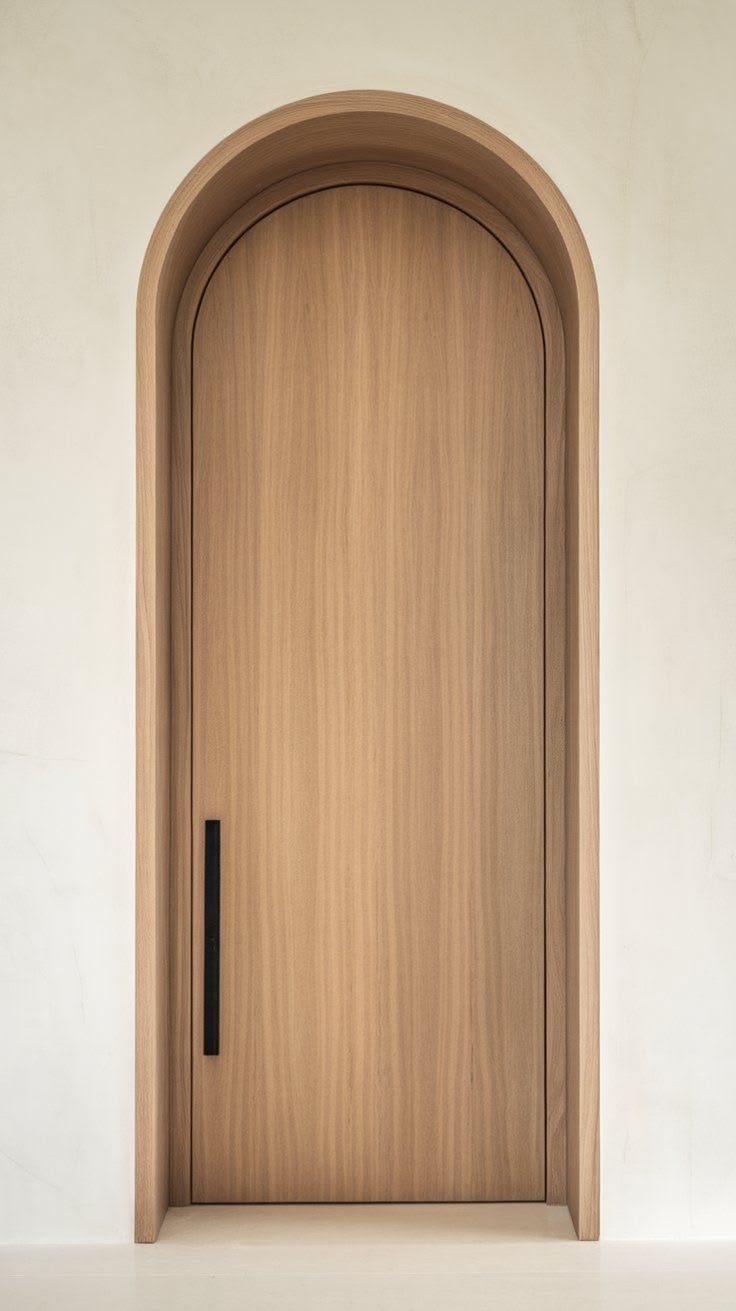
The facade study shown here has vertically slatted panels set beneath a deep roof projection, with a curved balcony edge interrupting the repeated lines. The door detail brings the scale down to one dark handle against a wood-colored surface. They are separate visual references, not a claim about one project or material. Together they suggest a useful change of viewpoint: step back to judge the arrangement, then move close enough to judge the encounter.
Choose the detail from the place where it will be used.
A finish sample should travel with the adjoining samples. Place it beside the actual cabinet face, door finish or wall surface, rather than beside a screen image of them. Look in the intended light where that is possible. Treat differences between samples as questions to resolve with the supplier, including what is representative and what variation may appear in the supplied product.
Separate appearance from specification
A persuasive sample is the beginning of the specification, not its substitute. Confirm the product, finish designation, dimensions and mounting arrangement with the current manufacturer information. Ask which components are included and which must be selected separately. A long pull, a latch and a door may appear together in a reference photograph without establishing that they form one workable assembly.
The drawing should connect the selected object to the receiving construction. Check fixing positions, clearance, opening direction and the relevant operation with the people responsible for design and installation. Record the unresolved items before the order is released. If a physical trial is needed, agree on a representative assembly and the question it must answer; a decorative mock-up should not be mistaken for a functional test.
Care deserves a separate conversation. Ask for the finish-specific cleaning instructions, the expected variation or change, and the available route to repair or replacement. Do not infer durability from a color name or from how polished the showroom sample appears. Where an answer matters to the decision, keep the supplier information with the approved selection so it can be found again.
Keep the choice attached to its location
A hardware schedule is more useful when every selection has a location. Give the door or cabinet an identifier and connect it to the drawing, product and approved finish. Mark exceptions explicitly. Repetition can make a room feel coherent, but it should be a considered decision rather than a shortcut that carries the same object into positions with different movements or clearances.
B&Co. Design | Build describes design, construction and material selection as one coordinated process. B&Co. Surfaces places architectural finishes alongside cabinetry and bathroom programs. The touch point belongs at that meeting: the larger design intent, the receiving surface and the practical assembly should be reviewed together, while each unanswered product or installation question remains visible.
Before accepting the installed detail, return to the original action. Open it from the intended approach, check the movement and compare the finish with the approved sample under ordinary room light. Record a discrepancy while its location and cause can still be examined. The decision is complete when the object can be judged where it belongs, with the same care given to its use as to its appearance.