On Stone
The Smallest Room, Taken Seriously
B&Co. Surfaces · November 24, 2026 · 4 min read
A bath is where a house is most honest about its materials. Water finds every shortcut, every soft stone and every seam placed for the photograph instead of the room — and a small room gives a weak material nowhere to hide.
Most rooms forgive. A living room can carry a mediocre floor for years because nothing tests it; a bedroom asks almost nothing of its surfaces. A bath asks everything, daily. It is the smallest room in the house and the only one where water is deliberately run against the walls and floor, where steam works into every joint, and where the same few square feet are used first thing in the morning and last thing at night. In a room that size, a material is not a backdrop. It is the whole decision, made at close range.
One stone, carried through
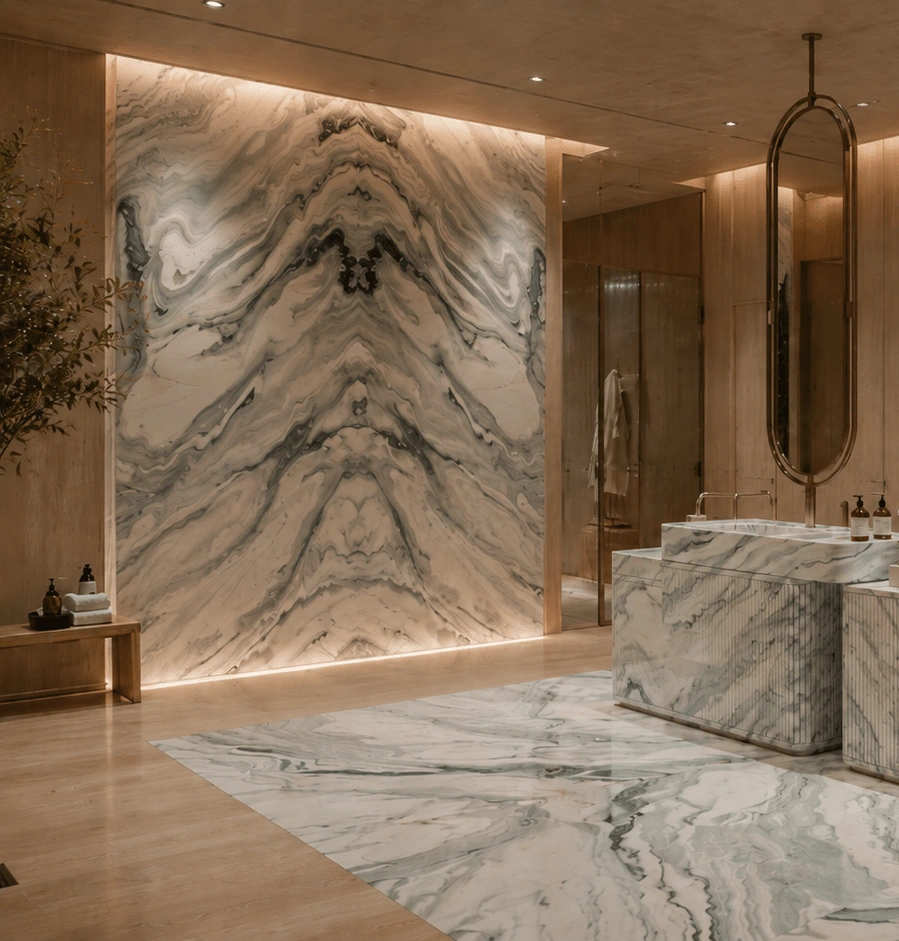
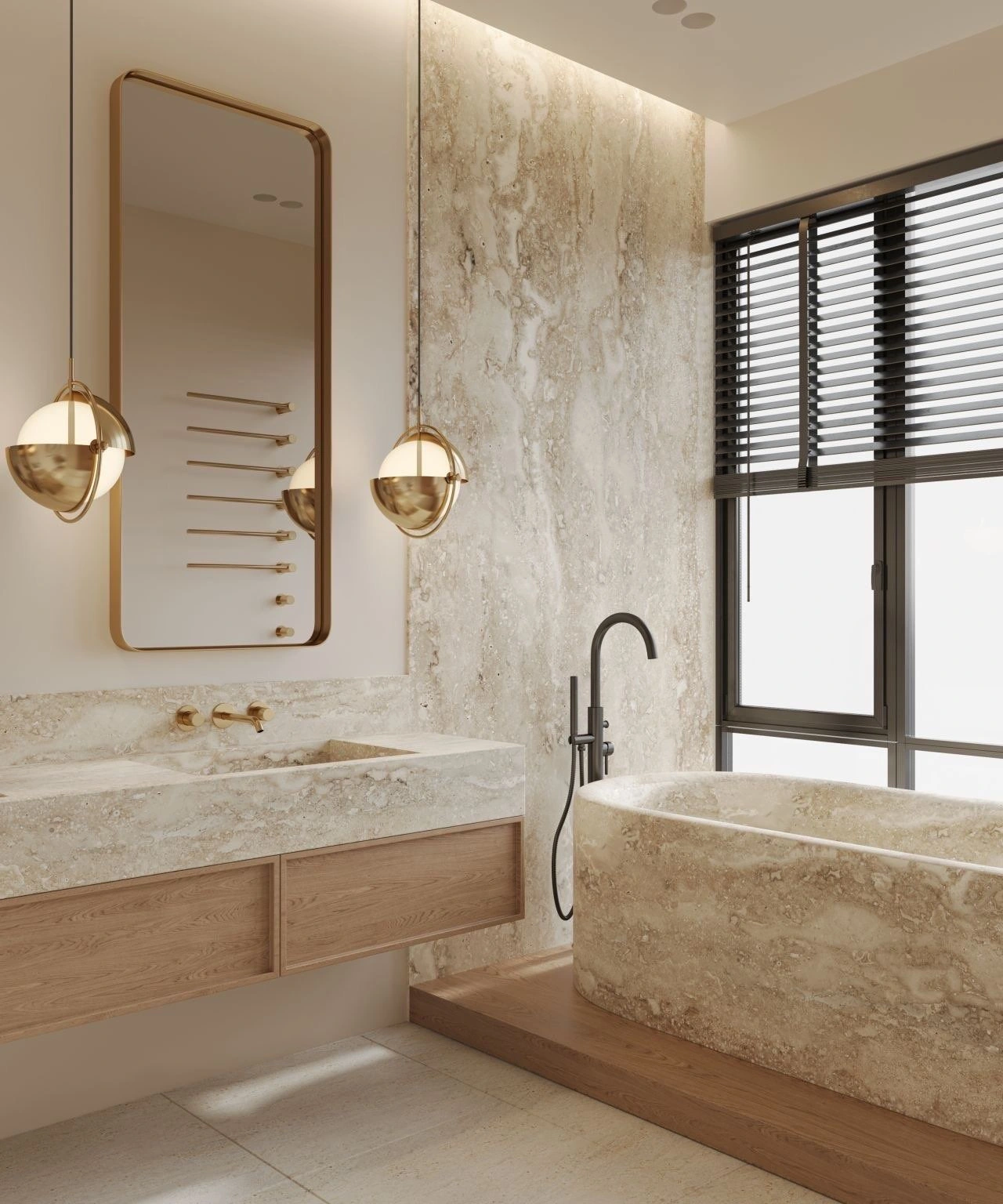
The discipline that works in a small bath is the opposite of the one that fills it: one serious stone, carried through the whole room. The shower wall, the floor underfoot, the vanity top — the same material, judged once and repeated. Repetition is what makes a small room read as composed rather than crowded. Every additional material in a bath that size is another voice in a small space, and the eye has nowhere to rest between them. One stone gives the room a single register, and the fittings, the glass and the light can stay quiet around it.
Carried through at full height, the stone also does the one piece of theatre a small bath can honestly hold: book-matching. Two slabs cut from the same block, opened like the pages of a book and set vein to vein, turn a shower wall into a single symmetric figure. It costs nothing in floor area — the room does not grow by an inch — and it is the difference between a wall that was covered and a wall that was composed. It also disciplines the rest of the specification: the bench, the niche and the threshold can be cut from the same stone, so the room's wettest corner is one continuous material with nowhere for a lesser surface to fail. In a large room that gesture can be lost. In the smallest room, it is the room.
Chosen for water, not for the photograph
A bath stone has to be chosen for water first and appearance second, and the worked example worth studying is Taj Mahal quartzite — a natural stone with a warm ivory base and soft gold veining that reads, at a glance, like marble. The figures that follow are drawn from Nova Tile & Stone's Taj Mahal quartzite guide. The resemblance is where the similarity ends. Quartzite ranks around 7 on the Mohs hardness scale, against marble's 3 to 5, and its dense composition is less porous, so a sealed surface sheds the daily water a bath throws at it instead of drinking it in. In the room where stone is soaked, steamed and wiped down every day, that hardness is not a specification. It is the whole argument.
The finish is the second half of the choice, and it is made for the water, not the showroom. Polished stone shows every droplet and water spot at close range; a honed finish, matte and low-sheen, forgives them and reads calmer under bathroom light; a leathered finish adds a slight texture that suits a floor, where grip under wet feet matters more than shine. The same stone can be specified three ways in one small room — polished where it is seen, honed where it is splashed, textured where it is stood on — and still read as one material.
Underfoot and at the vanity
This is the work the B&Co. Surfaces library in Closter exists for: a commission's stone judged as one decision — slab, vein direction, seam placement and finish for each plane it will cover — before anything is cut. In B&Co.'s own documented bathroom work, the pattern is the same one argued here: natural stone vanities, and tile underfoot and on the walls, the wet surfaces of the room carried in stone rather than decorated around it. The vanity is where the discipline shows most, because it is the surface touched and seen closest, twice a day, at arm's length.
A small room cannot hide a weak material. It can only honour a strong one, at close range, every day.
Care, specified like everything else
Taken seriously also means the care is specified, not discovered. Quartzite is sealed before first use and resealed on a stated cycle — the guidance for Taj Mahal quartzite puts it at every 12 to 18 months — and that small obligation is written into the room's life the way its grout lines and falls to the drain are. A stone chosen this way does not ask to be admired and then forgiven. It asks to be maintained on a schedule, and in return it holds the smallest room in the house to the standard of the largest.