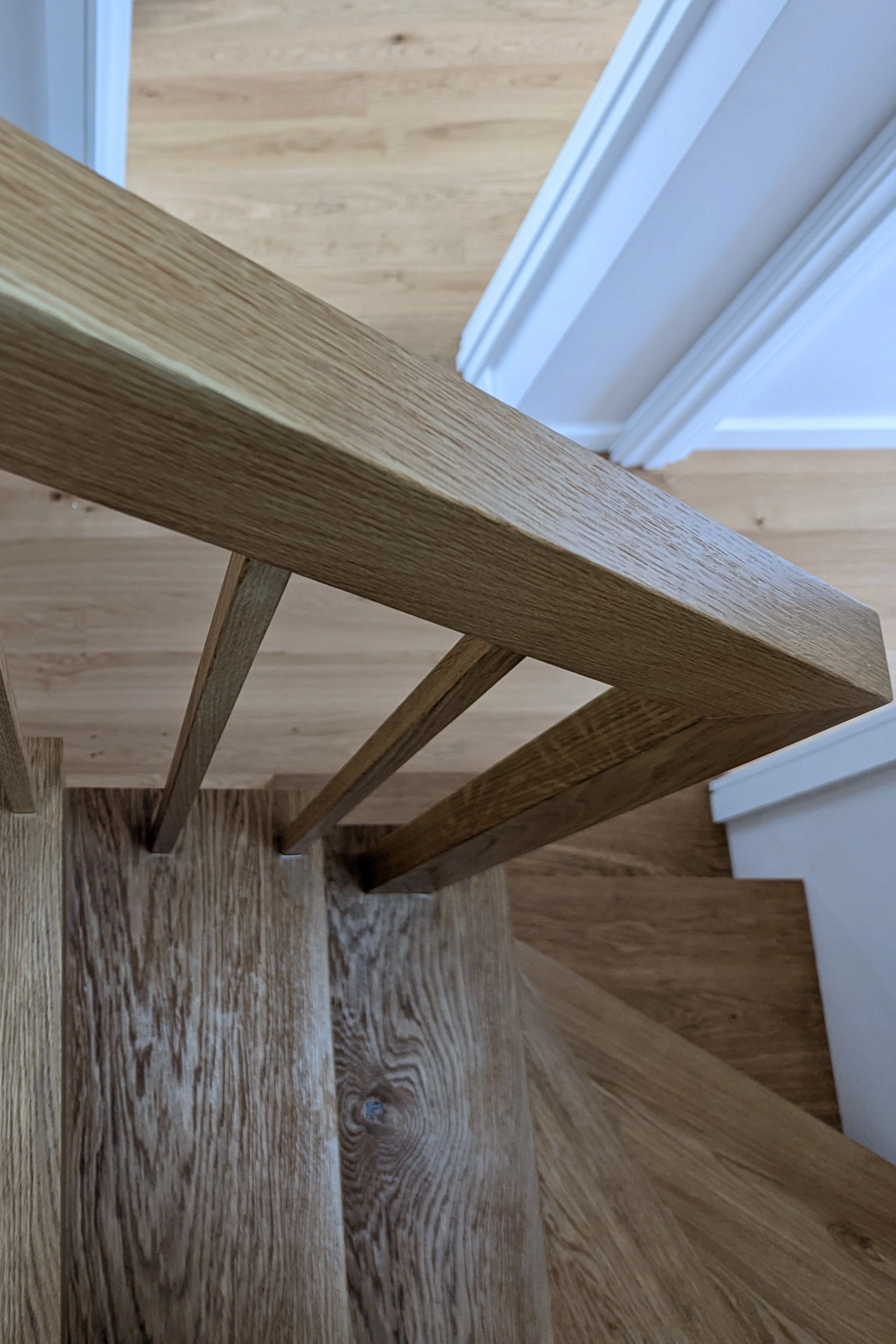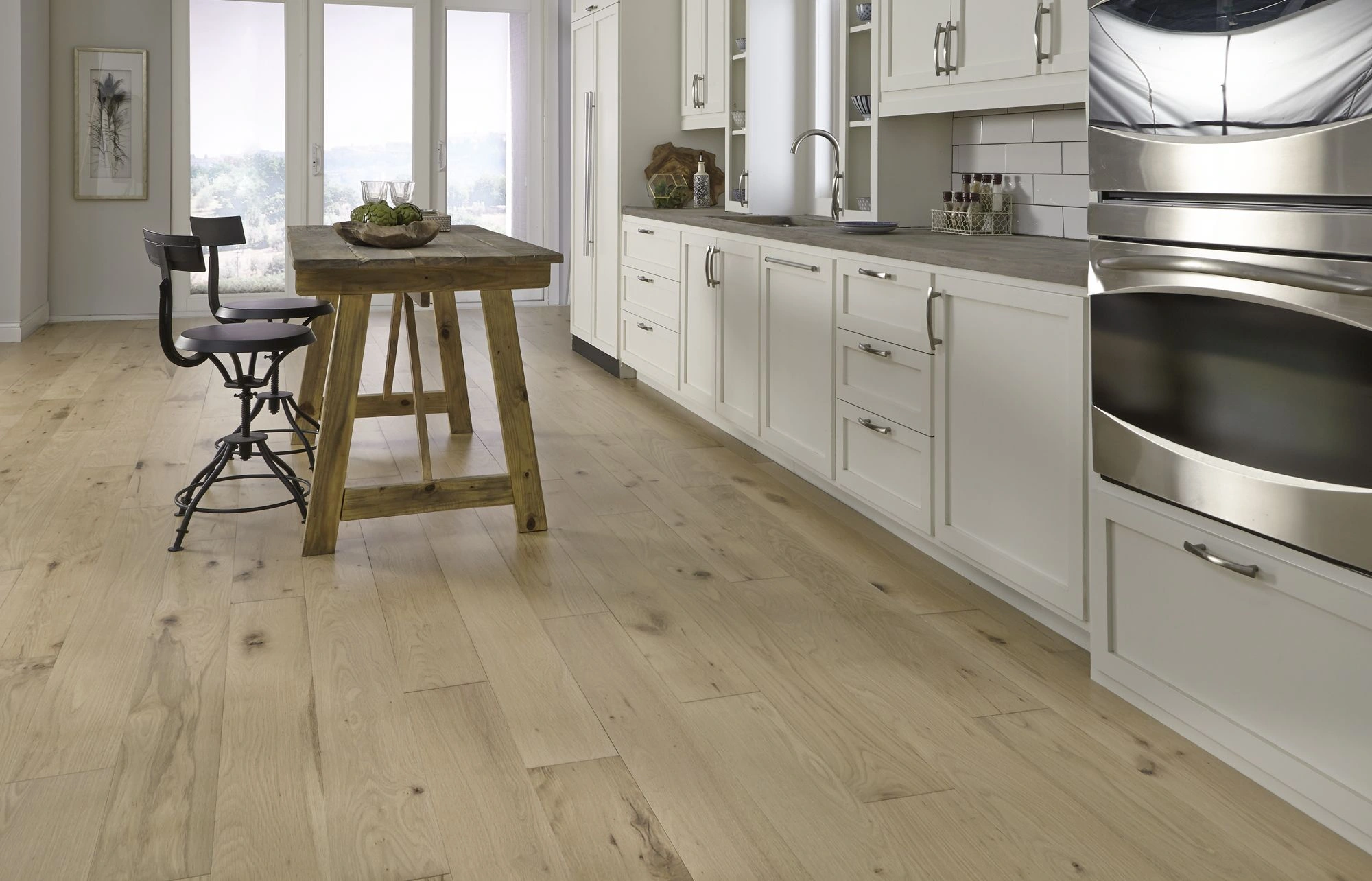
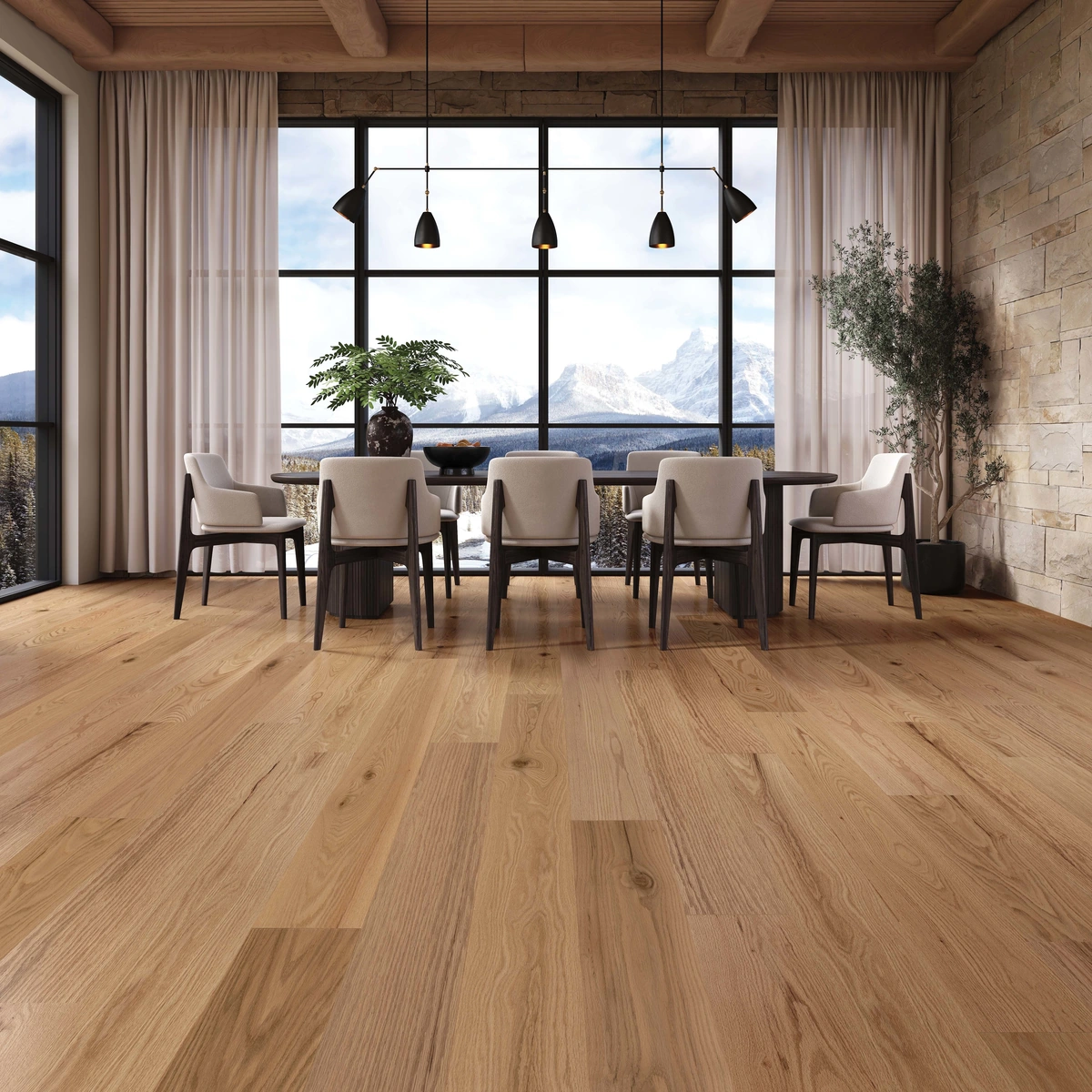
Most floor conversations start with species and finish, as if the board arrived already patterned. It did not. Between the log and the room stands one decision that does more for a floor's character than either: how the log was cut. The same white oak — a hard species, rated 1,360 lbf on the Janka hardness scale — can leave the mill wearing three different faces, and a house floored in one will feel different from a house floored in another.
Three cuts, three tempers
Plain-sawn stock is cut straight through the log in parallel slices, its face meeting the growth rings at a shallow angle. The result is cathedral grain: tall, nested arches that rise and fall along the board — handsome, traditional, and animated. It is a floor that keeps moving when the room is still. In one room that movement can be the point; carried through a whole house, it is a rhythm with a strong accent every room must take.
Rift-sawn and quarter-sawn stock come from the log's other geometry. Quarter-sawn boards, cut with the rings standing steep to the face, show straight grain crossed by ray fleck — the medullary rays of the tree exposed as pale ribbons that appear and vanish as you cross the room. Rift-sawn boards, cut on the diagonal, give the straightest read of all: tight, linear grain, minimal fleck, the most even temper across a run. Where plain-sawn grain arches, rift grain proceeds, line after line, at one pace. The distinction is not a stylist's invention: the U.S. Forest Products Laboratory's Wood Handbook separates oak flooring by grain direction into plain sawn, quartersawn, rift sawn and quarter/rift grades.
That discipline is the one B&Co. specifies. In B&Co.'s documented Alpine renovation, the flooring is rift-cut quartered white oak carried throughout — one cut, one grain direction, room after room — with natural stone vanities and tile in the bathrooms, where water does the work. The floors were composed through B&Co. Surfaces, the firm's materials library in Closter, where the cut is chosen from the board itself, not a photograph of one. Nothing announces itself; it is simply why the rooms hold together.
Width is a rhythm decision
Board width sets the tempo. A narrow board repeats often, and its joints draw a fine, frequent beat across the floor; a wide plank repeats rarely, shows more of each board's face, and asks that face to carry the room. Width and cut therefore cannot be chosen separately. A wide plain-sawn plank gives the cathedral arch a large stage, board after board; a wide rift-sawn plank lets straight grain run unbroken, and the floor reads as a calm field rather than a pattern. The wider the board, the more the cut is the design.