On Material Language
One Language, Every Room
B&Co. Design | Build · November 19, 2026 · 4 min read
Separate rooms become one commission when they speak the same material language: the same glass, the same stone and the same wood, decided once in one place and repeated without improvisation from the entrance to the pool terrace.
A house can be well built room by room and still read as a collection. Each room is finished competently, each material is defensible on its own, and yet the whole never settles into a single statement, because every room was negotiated separately. The failure is rarely one of quality. It is a failure of language: too many vocabularies, introduced one decision at a time, until the house is fluent in none of them.
Three materials, decided once
The alternative is to decide the language before the rooms. A small palette, chosen whole, and then held: the same stone returning in room after room, the same wood answering it, the same glass forming the walls between them. Repetition of this kind is not economy and it is not caution. It is what allows a large house to be read in one glance and remembered as one place, because the eye learns the vocabulary early and then keeps meeting it, varied but never contradicted.
Deciding once has a practical address. At B&Co., the palette of a ground-up commission is composed in the B&Co. Surfaces library in Closter, from one inventory, with the stone, the wood, the kitchen and the closets set against each other on one table before construction begins. A language settled there does not have to be renegotiated on site, room by room, month by month. It arrives as a decision already made, and the build's work is to carry it, not to reinvent it.
The Church Street evidence
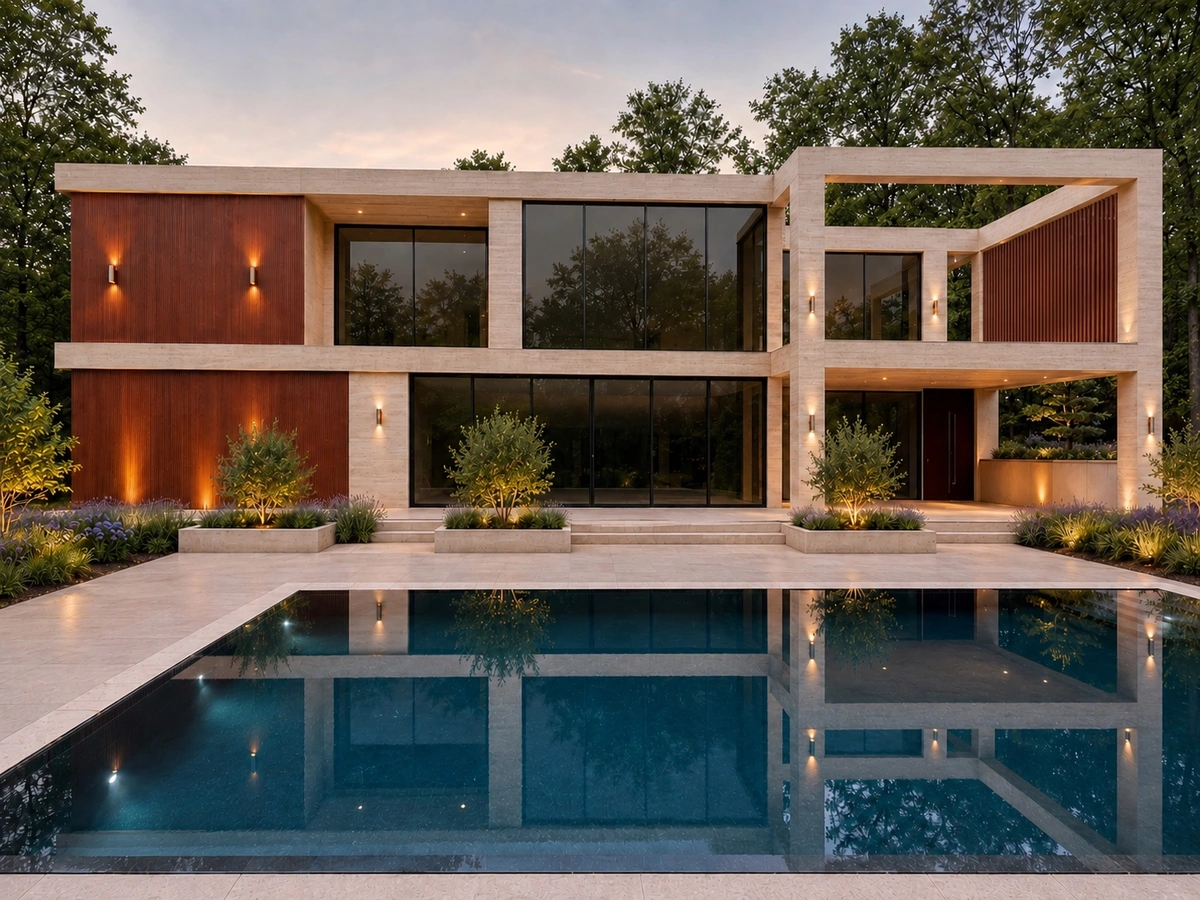
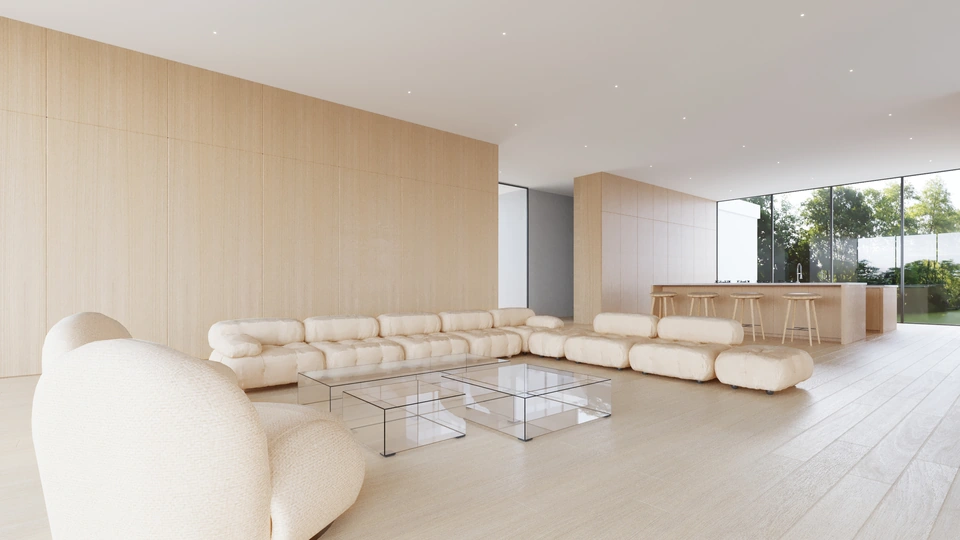
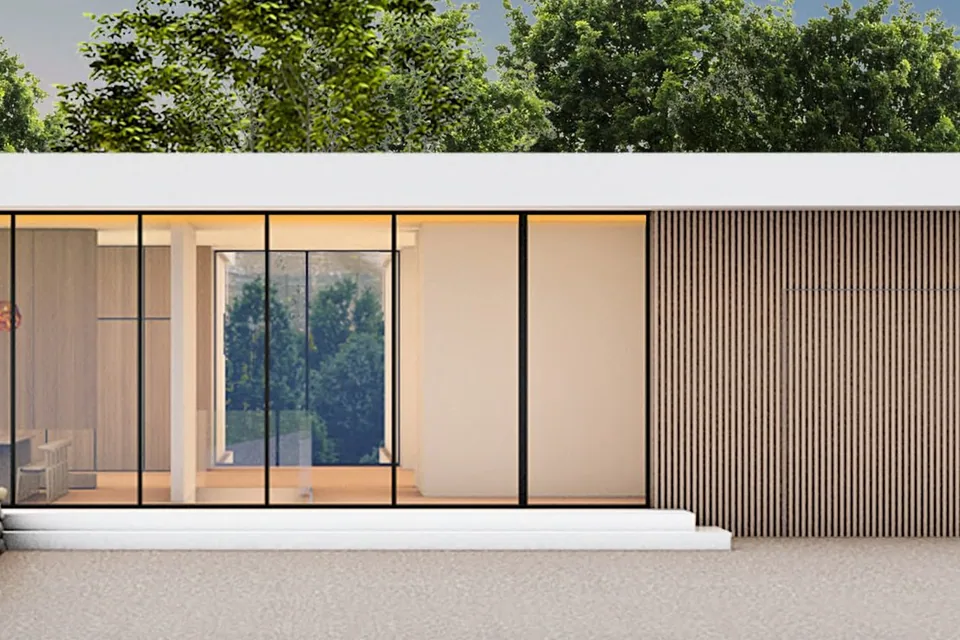
At 23 Church Street in Alpine, B&Co. Design | Build designed and built a residence of approximately 10,000 square feet from the ground up over two years — seven bedrooms and eight bathrooms on 1.40 wooded acres, carried on steel framing under twelve-foot ceilings on every level. The palette is one language in three materials. Monumental glass, in panels five feet by twelve feet recessed into both floor and ceiling with under an inch of frame between them, forms the walls. Natural travertine runs from the principal interiors out to the glass-and-travertine pool house. Natural Wenge wood answers the stone throughout.
The test of a language is whether it survives changes of scale and use. In the principal rooms it is carried by the glazing and the twelve-foot ceilings. At the center of the plan, the double-height dining room lets the horizontal discipline break upward, and the same materials hold the taller room without a new vocabulary being introduced for it. In the kitchen and the closets — the rooms touched most often — the same Surfaces palette continues, so the working rooms carry the same register as the formal ones rather than dropping into a second, lesser set of finishes.
Repetition is the discipline
Carrying one language outdoors is where many houses quietly give up, exchanging their interior materials for a separate exterior set. At Church Street the grounds were designed as part of the architecture: the pool house repeats the glass and the travertine, a broad pool terrace extends the stone underfoot, and a reflecting pool holds the rear elevation in still water, doubling the composition before the eye reaches the lawn. Even the working parts keep the standard — a 12-car garage and a radiant-heated driveway, specified to the same level as the rooms in front of them.
A house reads as one commission when no room has to introduce itself in a new language.
What one language asks
The discipline is demanding in a specific way: it moves the hard decisions to the beginning. The palette has to be right before the structure rises, because it will be repeated too often to be corrected later, and every later choice — a kitchen, a closet, a terrace — is measured against a language that already exists. The full record of the house, in the 23 Church Street property presentation, shows what that discipline produced across two years of building: one vocabulary, held from the entrance to the pool house.
For anyone planning a ground-up build, the lesson is portable. Choose the language first, choose it in one place, and let repetition do the work that novelty is usually asked to do. Rooms will still differ — in scale, in light, in use. What they will not do is argue with each other.